

3-5 Gallon Filling Machine: Working Process and Production Guide
Learn how 3-5 gallon filling machines rinse, fill, and cap water barrels and how to choose equipment
The 3-5 gallon filling machine is designed for bottled water plants producing 3-gallon and 5-gallon reusable water containers. It combines the main production processes of barrel rinsing, water filling, and capping into one integrated system.
By combining these operations, the machine reduces manual handling and improves coordination between different production stages. Accurate filling components, automatic controls, and a practical mechanical structure help water plants maintain consistent production during daily operation.
The equipment can be used for purified water, mineral water, and drinking water production, depending on the water source, treatment process, container specifications, and production requirements.
What Is a 3-5 Gallon Filling Machine?
A 3-5 gallon filling machine is an integrated piece of water bottling equipment used to clean, fill, and seal reusable large-capacity water barrels.
Unlike small PET bottle filling equipment, this type of machine is specifically designed to handle larger reusable containers. The production process generally requires thorough internal rinsing before filling to prepare each barrel for hygienic water production.
The main functions typically include:
Empty barrel feeding
Barrel rinsing
Water filling
Automatic capping
Bottle or barrel conveying
Production control
The exact configuration can vary according to the required production capacity, barrel specifications, water treatment process, and factory layout.
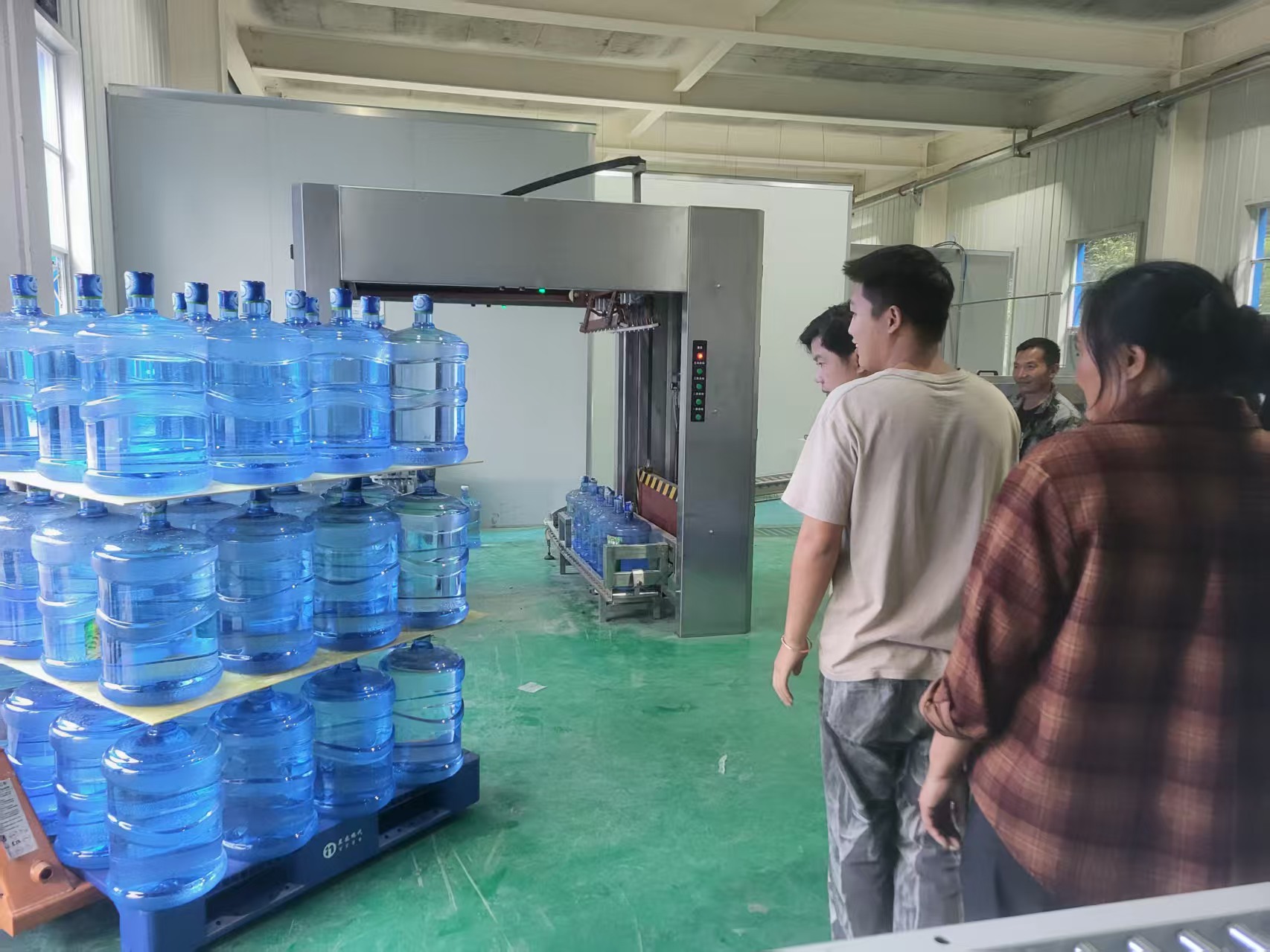
Working Process of a 3-5 Gallon Filling Machine
The machine completes several production stages in sequence. Empty barrels enter the equipment and are transferred between different processing units, with each section performing a specific function.
1. Barrel Rinsing
The rinsing system cleans the inside of empty reusable barrels before filling.
This stage helps remove possible residues and prepares the containers for the filling process. Proper barrel preparation is particularly important for reusable water containers because they may return to the production facility after previous use.
The rinsing process works as part of the continuous production cycle, allowing prepared barrels to move directly to the filling section.
2. Water Filling
After rinsing, the barrels enter the filling section.
The filling system uses controlled filling components to deliver the required amount of water into each container. Stable liquid control helps maintain consistent filling volume during continuous production.
Filling parameters can be adjusted according to the equipment configuration and production requirements.
3. Capping
Once filling is completed, the barrels move to the capping section.
The capping unit seals the filled containers and completes the main bottling process. Automatic capping reduces manual handling and allows the filling and sealing stages to operate continuously.
The integrated workflow helps improve coordination between rinsing, filling, and capping.
How the Filling System Improves Production Consistency
The filling system is one of the most important sections of the equipment because filling consistency directly affects finished product volume and production efficiency.
Accurate filling valves and controlled liquid flow help the machine maintain a consistent filling level from one barrel to another.
During operation, production parameters can be adjusted according to actual requirements. The control system coordinates the filling process and helps maintain stable operation during continuous production.
Consistent filling can also help reduce unnecessary product variation and support more predictable daily output.
For water plants operating for extended periods, stable filling performance is especially important because small variations can accumulate over a large production volume.
How the Rinsing System Prepares Reusable Water Barrels
Unlike single-use containers, reusable 3-gallon and 5-gallon barrels need to be properly prepared before they are filled again.
The rinsing system is designed to clean the internal surfaces of empty barrels and remove possible residues from previous use.
The rinsing stage normally forms part of the integrated production cycle rather than operating as an independent manual process.
A coordinated rinsing, filling, and capping workflow can help:
Reduce manual barrel handling
Improve production continuity
Prepare containers before filling
Maintain a more organized production process
Improve coordination between equipment sections
The exact rinsing configuration should be selected according to the barrel condition, water quality requirements, production capacity, and applicable production standards.
Automatic Control System for Easier Operation
Modern 3-5 gallon filling machines can use automatic control systems to coordinate different production stages.
Operators can monitor machine operation and adjust production settings according to actual requirements. The control system connects the main working units so that rinsing, filling, and capping can operate as a coordinated process.
Depending on the machine configuration, control functions may include:
Automatic production control
Filling parameter adjustment
Equipment status monitoring
Fault detection
Production sequence control
Automatic machine stopping
An appropriate control system can reduce unnecessary manual adjustments and make daily operation easier for production staff.
However, the ideal automation level depends on the plant's production capacity, labor availability, technical requirements, and investment plan.
3-5 Gallon Bottling Equipment for Different Water Products
3-5 gallon bottling equipment is commonly used in water plants producing different types of drinking water.
Typical applications include:
Purified water
Mineral water
Drinking water
The machine itself does not determine the type of water being produced. The final water quality depends on the source water, treatment process, filtration system, disinfection method, and applicable production requirements.
For this reason, the filling machine should be considered as one part of the complete water production system.
A complete large-container water production line may combine the filling equipment with:
Water treatment equipment
Bottle or barrel washing systems
Conveyors
Filling and capping equipment
Labeling equipment
Packaging equipment
How to Select the Right 3-5 Gallon Filling Machine
Different water plants have different production requirements, so equipment should be selected according to actual operating conditions.
Before purchasing a machine, consider the following factors.
Production Capacity
Determine how many 3-gallon or 5-gallon barrels you need to process per hour.
The required output should be based on actual market demand and future production plans rather than selecting the highest available machine speed.
Barrel Specifications
Check the dimensions, material, shape, and design of your reusable barrels.
The equipment should be compatible with the containers used by your production line.
Water Treatment Process
The filling machine should be properly matched with the upstream water treatment system.
The complete process may include filtration, purification, disinfection, and other treatment stages before water reaches the filling section.
Factory Layout
Consider the available workshop space and the position of:
Water treatment equipment
Filling machine
Conveyors
Packaging equipment
Finished product storage
A well-planned layout can improve material flow and reduce unnecessary handling.
Automation Level
Choose an automation level that matches your production capacity and workforce.
For higher-volume water plants, automatic rinsing, filling, and capping can reduce manual operations and improve production continuity.
Stable Machine Design Supports Long-Term Production
For water plants, equipment reliability is important because production may continue for many hours each day.
A practical 3-5 gallon filling machine should focus on stable operation, accessible maintenance points, and reliable coordination between its main working units.
Regular maintenance is also necessary to maintain equipment performance.
Operators should routinely check:
Filling components
Rinsing systems
Capping mechanisms
Conveyors
Sensors
Control components
Water-contact parts
Following the manufacturer's maintenance recommendations can help identify potential problems before they cause significant production interruptions.
Build a Complete 3-5 Gallon Water Bottling Solution
A filling machine is only one part of a complete large-container bottled water plant.
For a new water project, manufacturers should evaluate the complete production process from water treatment to finished product packaging.
A typical workflow may include:
Water Source → Water Treatment → Barrel Preparation → Rinsing → Filling → Capping → Labeling → Packaging → Finished Product Storage
This approach allows each section of the production line to be properly matched according to capacity and operating requirements.
For example, if the filling machine has a higher capacity than the upstream barrel preparation system, the overall production line may not reach the expected output. Similarly, insufficient downstream packaging capacity can create bottlenecks after filling.
Therefore, production capacity should be considered across the entire line rather than for the filling machine alone.
Conclusion
A 3-5 gallon filling machine combines barrel rinsing, water filling, and capping into an integrated system designed for large-container bottled water production.
Its main advantages include reduced manual handling, coordinated production processes, consistent filling, and convenient automatic operation.
When selecting equipment, water plants should consider production capacity, barrel specifications, water treatment requirements, workshop layout, automation level, maintenance, and future expansion plans.
For a new bottled water project, the filling machine should also be properly integrated with the upstream water treatment system and downstream labeling and packaging equipment. A complete and well-matched production line can provide a more stable foundation for long-term bottled water manufacturing.
Article Summary
The 3-5 gallon filling machine is designed to process reusable 3-gallon and 5-gallon water barrels through rinsing, filling, and capping. Its integrated design reduces manual handling and helps improve production coordination.
The equipment can be used for purified water, mineral water, and drinking water production. When selecting a machine, manufacturers should evaluate production capacity, barrel specifications, automation, factory layout, water treatment requirements, and long-term maintenance needs.
For larger projects, integrating the filling machine with a complete water treatment, labeling, and packaging system can help create a more efficient and reliable bottled water production workflow.
Article Abstract
A 3-5 gallon filling machine is integrated equipment for reusable large-container water production. It combines barrel rinsing, water filling, and capping in one production system. This guide explains its working process, control system, applications, selection factors, and role in a complete bottled water production line.
FAQ
What is a 3-5 gallon filling machine?
A 3-5 gallon filling machine is equipment designed to rinse, fill, and cap reusable 3-gallon and 5-gallon water barrels. It is commonly used in purified water, mineral water, and drinking water plants.
What processes does a 3-5 gallon filling machine include?
The main processes are barrel rinsing, water filling, and capping. Depending on the production line configuration, the machine can also connect with conveying and other packaging equipment.
Can the machine fill both 3-gallon and 5-gallon barrels?
The equipment can be configured for different large-container specifications. Compatibility depends on the barrel dimensions, machine design, and selected configuration.
What type of water can be produced with this equipment?
The equipment can be used for purified water, mineral water, and drinking water production when properly integrated with the corresponding water treatment system.
How do I choose the right 3-5 gallon filling machine?
Consider production capacity, barrel specifications, water treatment requirements, automation level, factory layout, maintenance requirements, and future production plans.
Can the filling machine be integrated into a complete water bottling line?
Yes. It can be combined with water treatment systems, barrel preparation equipment, conveyors, labeling machines, and packaging equipment to create a complete large-container bottled water production line.
Request Pricing
Name
Whatsapp
Email*
Message*
- I have read and agree with 《Privacy Policy》